Market Bubble Indicator: How to Tell If a Stock Is in a Bubble
You can tell a stock or market is entering bubble territory when price stretches far above its long-term trend after a massive, rapid run-up. Watching when that overheated stretch finally breaks back below the 200-day moving average helps signal when the party may be ending.
What Market History Says About Bubbles
Jeremy Grantham, co-founder of GMO, has spent decades studying major financial bubbles across global markets. He defines a bubble as a price move far above its long-term trend, specifically a 2-sigma statistical event. He also notes that major technological innovations frequently spark the biggest speculative bubbles.
On a price chart, two classic warning signs stand out during these episodes. First, the asset posts an unusually large percentage gain in a relatively short window. Second, the price pulls far away from its 200-day moving average as buyers chase momentum regardless of valuation.
Reading Overheated Stretches and Trend Breaks
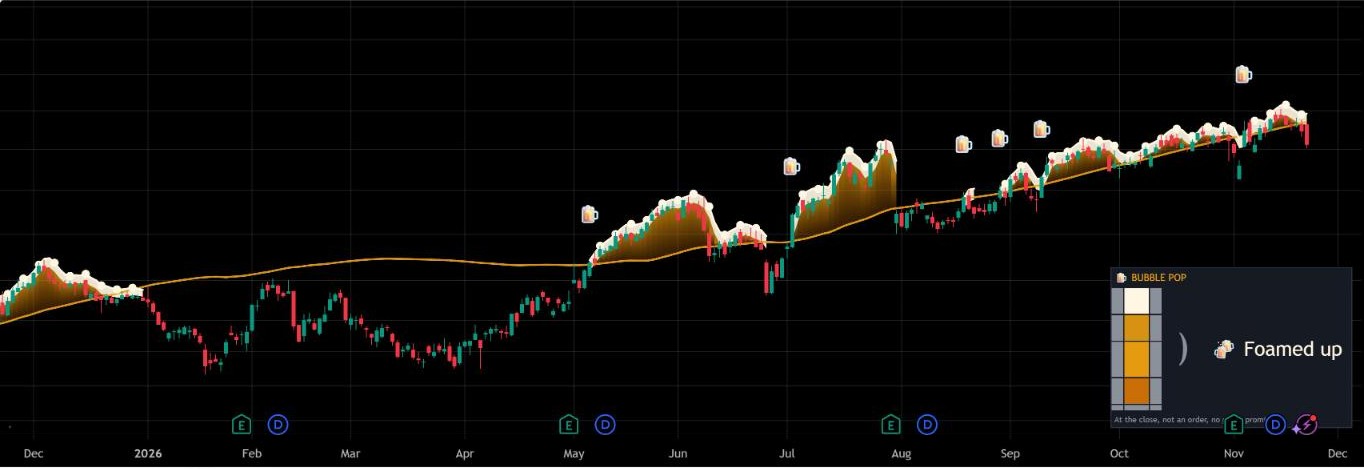
Bubble Pop translates these bubble mechanics into simple visual cues using a beer glass theme on your chart. A gold bubble line tracks the upper stretch threshold above the trend. When an asset pushes into an overheated zone above that gold line, a beer-glass mark appears to signal a bubble party phase.
The critical warning comes when momentum cracks. If an asset has surged more than 100% over 2 years and then closes back beneath its 200-day moving average, a red foam gone mark prints on the chart. An on-screen status panel displays whether the asset is currently Foamed up, Just right, or Foam gone.
What 20 Years of Testing Showed Across 18 Assets
We tested Bubble Pop on daily bars across 18 global assets from 2005 through November 20, 2026. Over that span, the rules triggered 228 foam-gone warnings after 100% two-year run-ups. Exactly 114 of those warnings, or half, saw prices sitting lower 6 months later than on the warning day.
This 50% split highlights an important lesson: a bubble break is a risk-management warning to be careful, not a guaranteed crash forecast. Meanwhile, slower-moving assets like Japan stocks and US long bonds never doubled within 2 years during the test, so they never received a warning.
Where Major Global Assets Stand Right Now
Checking the status panel at the market close on November 20, 2026 shows a clear split across the 18 tracked assets. Apple stood alone in the Foamed up state, trading above its trend stretch threshold.
Six assets sat in the Foam gone warning state after big prior runs: gold, silver, Nvidia, Google, Meta, and Tesla. The remaining 11 global assets in the group read Just right, trading within normal trend boundaries without extreme bubble heat.
Frequently asked questions
What is the main sign that a stock or market is in a bubble?
A rapid, outsized price surge that pushes an asset far above its long-term trend, such as a 2-sigma move, often while price sits far above the 200-day moving average, is the clearest technical sign of bubble conditions.
Does a bubble warning mean prices will definitely crash?
No. In tests across 18 global assets from 2005 to November 2026, price was lower 6 months after a foam-gone warning in 114 out of 228 cases, or 50%. Treat the warning as a cue for caution rather than a guaranteed drop.
Why do some assets never trigger a bubble warning?
The warning rule requires an asset to rise more than 100% over 2 years before closing back under its 200-day average. Steadier assets like Japan stocks and US long bonds never had a 100% two-year surge in our test period.
Monitor Bubble Heat and Trend Breaks with Bubble Pop
Bubble Pop is a TradingView Pine Script indicator featuring a gold bubble line, a live status panel in 8 languages, and 4 built-in alerts for overheated stretches and 200-day trend breaks. You receive complete Pine Script source code ready for any chart.
Check Out Bubble Pop →Bubble Pop is an indicator to help chart analysis, does not guarantee profit, investing has risk of loss, and past test results are calculated on past data and do not guarantee future returns.